
There is so much talk about product-market fit in the startup world. You could say that there is nothing new under the sky. In my last post I wrote about the noise in the market, which is nothing more than what a product creator should hear and act upon. That is almost right. Anything I can add to it will be understood if I tell you what the overall goal of my posts is. I want to create a mathematical method that shows whether a startup is worth investing in or not. To do this, I need numbers that show the necessary and the exclusionary conditions.
Exclusionary conditions
Many of the readers of this article share my experience of reading the book Hooked by Nir Eyal and Ryan Hoover. Nir describes a loop model of how a given product creates habits. Some elements of the model can be measured and expressed numerically. We can more or less determine how likely a product is to develop good or bad habits. But what’s good? Broadly speaking, anything that does not damage your health, whether physical or mental, is good, and anything that teaches you something necessary for an honest and balanced life is very good. So, we have a “tool” to disclose dangerous products. But will the market like what is good for it?
What people say
Ford has been known to say of potential buyers of his cars that people would have liked faster horses. This means that people do not know what kind of technical innovations they would like. But it doesn’t cover how well they know the problems they’re running into. And luckily for startup founders (or thank God), they do talk about it from time to time. Because they talk about it on the internet, founders have a great chance of hearing about these problems. But how? An example helps more than 2000 pages of theory. So, look…
Let’s say you want to create an application where ideators can enter their text, audio or drawing ideas throughout the day, and the AI part of the application sorts and stores them based on their content, and from time to time notifies the users that they had such and such an idea. How do we know there is a demand for this? If a lot of people complain about forgetting their ideas, or if more people complain about forgetting than stealing, then it’s worth looking into making an application. OK.
There are a lot of social listening tools. I have chosen one. I typed the following into the search bar: forgot my idea. The result is that only a small number of people have talked about it, and not much less those who have talked about it positively than negatively, but the percentage of people involved is high. This is shown in the next picture.
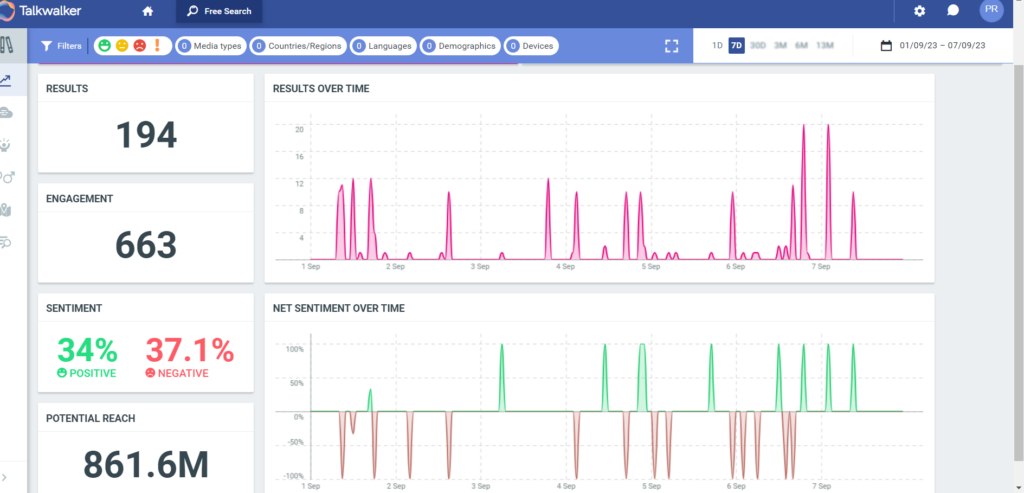
So, what should we do?
The figure I calculate from this data is not ready to be published. But I can tell you that before we calculate the figure we should do more research and if we get a better ratio, it is enough not to throw the idea out of the window. But to make a good investment we need to measure many more things and we need to investigate social listening applications more. I will write about this in 14 days. Until then bookmark my blog in your browser.
What is the most important take-aways?
- Exclusionary conditions are factors that help identify products that may be harmful, either physically or mentally. Using principles from Nir Eyal’s book Hooked, the author suggests these conditions can be quantified to assess the potential impact of a product.
- Listening to the market by leveraging social listening tools to analyze what people are saying about problems they face. The example given involves searching for discussions around “forgetting ideas” to evaluate demand for an idea-storing AI application.
Leave a Reply